Confirm real presence. Block every spoofing attack.
ASTERIA KYC biometric liveness detection determines whether the person submitting the selfie is physically present. Passive analysis, active challenge response, and injection attack detection run in sequence to return a single structured liveness result.
A real-person check that resists screen replays, printed photos, and injection attacks.
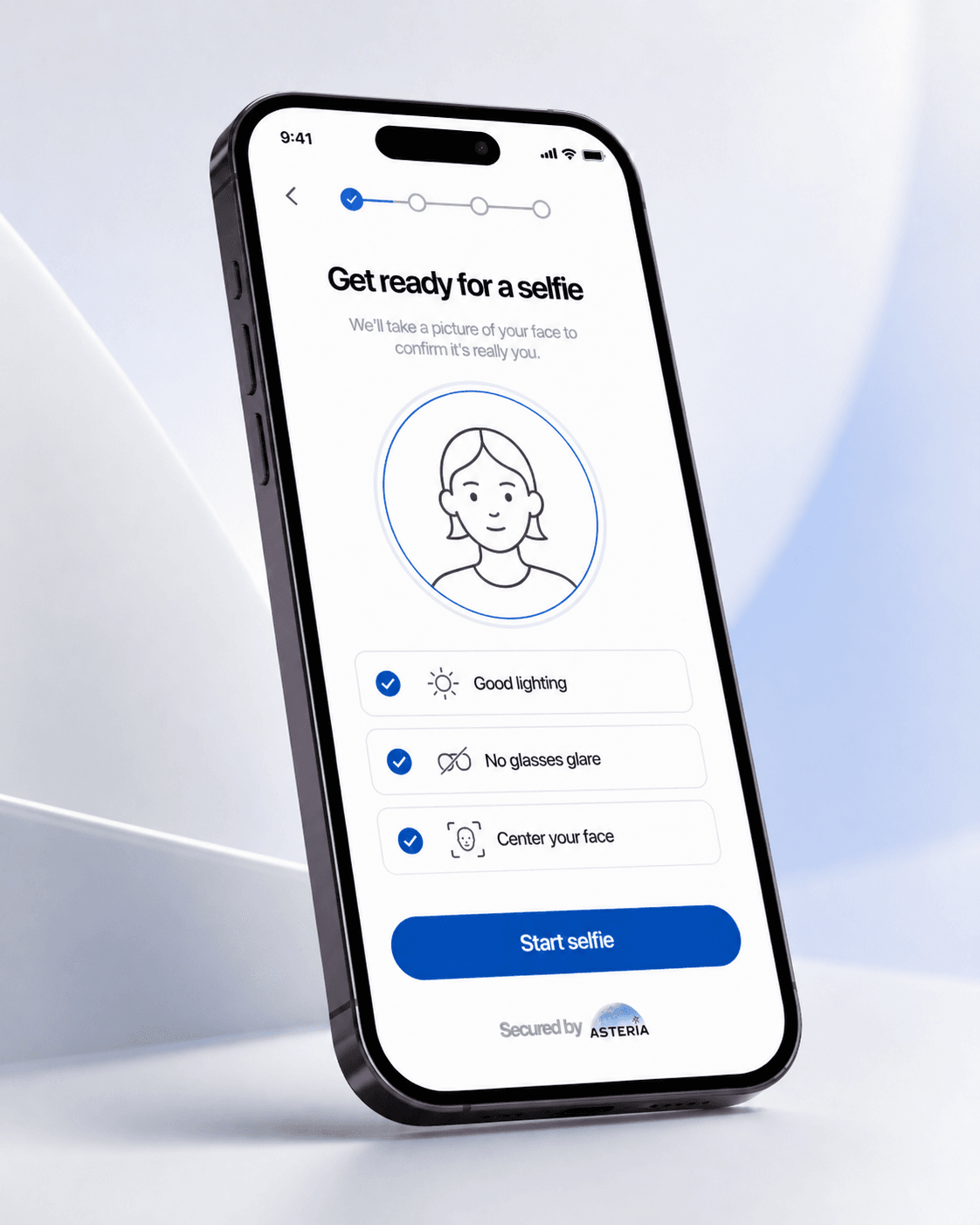
Three layers of detection. One liveness result.
Passive analysis runs first on every session. Challenge and injection layers activate where the passive signal warrants escalation.
Passive Analysis
Frame-level biometric signals analyzed without user interaction. Texture, depth cues, and micro-movement patterns assessed in the submitted capture.
Active Challenge
Randomised challenge sequence presented when passive signals are uncertain. Head movement, blink, or expression prompts configured per session.
Injection Attack Detection
Virtual camera, emulated device, and media injection signals detected at the session layer before biometric analysis begins.
Face match, anti-spoof signals, and capture guidance —every step instrumented for audit-ready evidence.
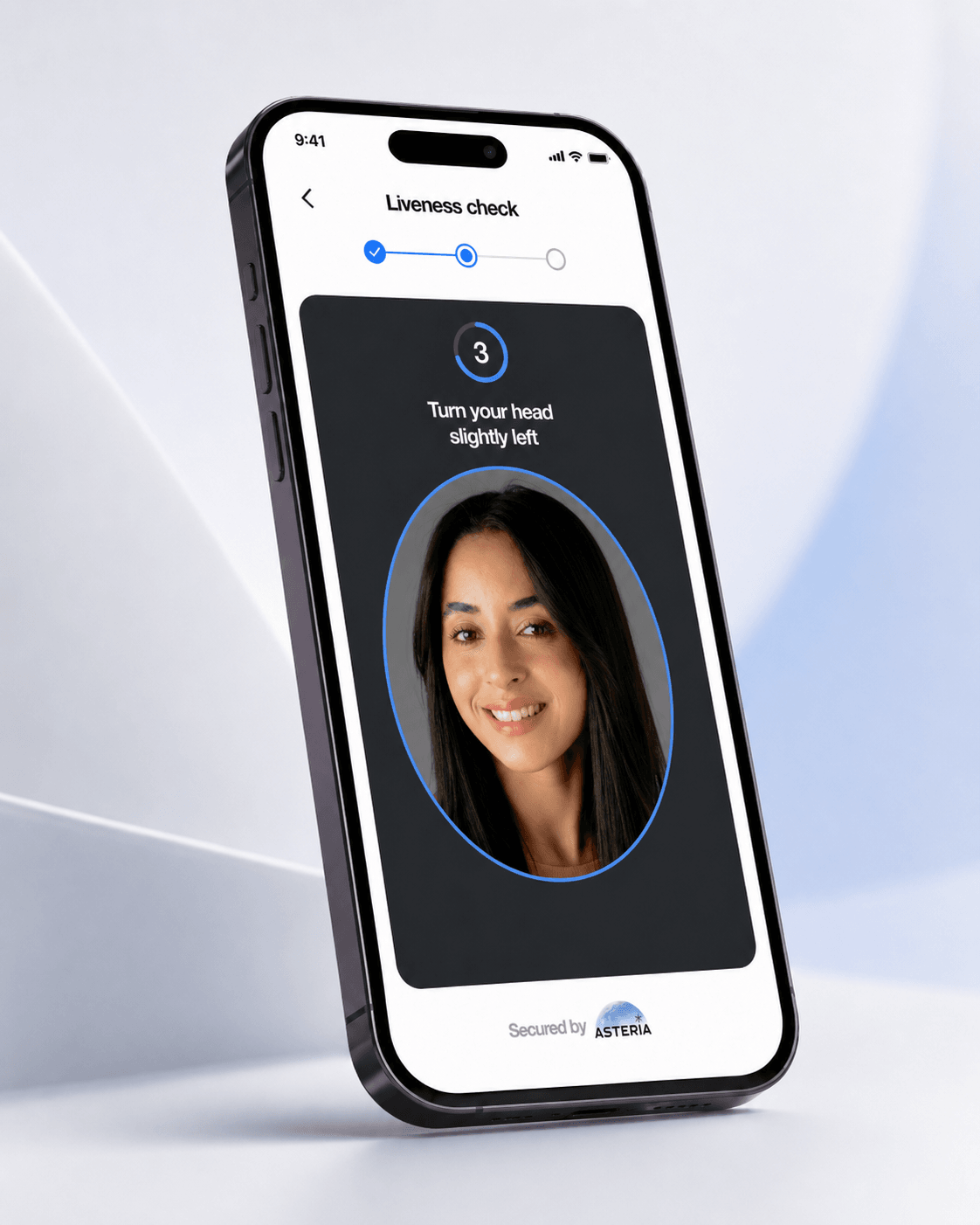
Every known spoofing vector. Covered.
Liveness checks are only meaningful if they cover the attack types that reach production. ASTERIA KYC covers the full range of known presentation attack categories.
Printed Photo
Static image printed or displayed on a second screen. Detected through texture depth analysis and micro-movement signal absence.
Video Replay
Pre-recorded video of the real user replayed during the session. Motion pattern analysis and frame consistency checks applied.
3D Mask
Silicone, paper, or rigid mask worn over the face. Surface texture analysis and depth signal inconsistency detection applied.
Deepfake Stream
AI-generated face substituted in real time during capture. Frequency artifacts, temporal consistency, and face boundary signals assessed.
Camera Injection
Virtual camera driver or media injection tool substituting the real device input. Session-layer device signal validation applied.
Partial Spoof
Photo or mask covering only part of the face. Face completeness validation and zone-level signal consistency checks applied.
Structured liveness result with confidence and reason codes.
Every liveness session returns a result code, confidence band, detected attack type where applicable, and reason codes for downstream use.
| Field | Description | Values |
|---|---|---|
| liveness_result | Overall liveness decision | passed / uncertain / failed |
| confidence_score | Liveness confidence | 0–100 |
| method_used | Detection method applied | passive / challenge / injection |
| attack_type | Detected attack category | none / print / replay / mask / deepfake / injection |
| challenge_result | Active challenge outcome | passed / failed / not_triggered |
| reason_codes | Structured reason array | array of strings |
{
  "liveness_result": "passed",
  "confidence_score": 96,
  "method_used": "passive",
  "attack_type": "none",
  "challenge_result": "not_triggered",
  "reason_codes": ["LIVENESS_PASSIVE_CLEAR"]
}Liveness outcome built for operational escalation.
Uncertain liveness results do not automatically fail the session. The result feeds into the risk score and may trigger human review based on configuration.
Passed
Passive or challenge analysis confirmed real presence. No spoofing signals detected. Confidence score above the configured threshold.
Uncertain
One or more signals returned low confidence. Image quality, motion pattern, or challenge response could not be resolved to a passing threshold.
Failed
A spoofing signal was detected above the failure threshold. Attack type recorded in the result. Session escalated or rejected based on platform configuration.
Ready to turn identity verification into a controlled compliance workflow?
Use ASTERIA KYC to verify users, screen risk, and preserve evidence from one connected platform.